

Last Updated on 22nd February 2026 by Steve
The Secret to Pain-Free Skiing All Day Long
You know the feeling. It’s 10:30 AM on a bluebird Tuesday at Vail. The corduroy is pristine, the air has that perfect high-mountain snap, and your friends are already disappearing into the glades with a shout. But you aren’t with them. You’re sitting on a cold wooden bench in the lodge, boots unbuckled, nursing a throbbing arch and “fire-toes.”
There is a specific, stinging kind of “resort shame” that comes with calling it quits early. It’s more than just physical discomfort; it’s a quiet theft of your identity. You didn’t fly across the country and drop two grand on a pass to stare at a cafeteria tray. You came to be a skier.
The barrier between you and those “First Tracks” isn’t your fitness or your bravery – it’s a simple failure of biomechanical engineering. Here is how you reclaim your day, your dignity, and your love for the sport.
The Physical Toll of the Slopes: It’s Never Just “Sore Feet”
To the uninitiated, agonizing ski boots are framed as a “tough it out” rite of passage. To a world-class bootfitter, that’s a physiological emergency. When your foot is trapped in a rigid shell, minor alignment issues don’t just stay minor; they are magnified by gravitational force until something snaps.
The “Cold Toe” Illusion: Nerve Compression vs. Temperature
Most skiers feel a chill and immediately reach for battery-heated socks. Usually, that’s a diagnostic dead end. “Cold toes” are frequently caused by ischemia – a lack of blood flow resulting from pressure on the dorsal artery or the peroneal nerve.
When your boot is too tight over the “instep” – that bony bridge on the top of your foot – you aren’t just cold; you are cutting off the fuel line to your extremities. If you’re feeling “pins and needles”, you don’t need more heat; you need more volume.
The Downward Spiral: How Pain Sabotages Your Form
Your brain is a survival machine. The moment your feet start screaming, your nervous system begins a series of subconscious compensations. You’ll sit back on your heels to take the pressure off your shins. This is the “backseat” position – the death knell of controlled skiing.
- The Price: Your quads burn out in twenty minutes, your tips lose contact with the snow, and you become a passenger on your own skis.
- The Breakout: Pain-free feet allow for Ankle Dorsiflexion, the ability to drive your knees forward and engage the ski’s sidecut. Modern skiing isn’t a feat of strength; it’s a dance of geometry.
The “Agony-Free” Checklist: 5 Fixes Before You Click In
Algorithmically, most “ski hacks” fail because they treat the symptom, not the source. To dominate the mountain, you have to optimize the interface where the human body meets the machine.
1. The Morning Stretch for Ankle Mobility
If your calves are tight, your heel will naturally lift inside the boot, causing friction and that dreaded “heel bang.” Spend five minutes on a slant board or stretching your Achilles before you even think about putting on your shells. A tiny increase in range of motion prevents the foot from “searching” for stability by cramping up.
2. The “Two-Finger” Buckle Rule
The most common sin? Over-tightening the lower buckles.
- The Real Secret: The two buckles across the top of your foot should be “closed,” but never “tight.” You should be able to flick them open with two fingers. The power and control of a ski boot come from the cuff – the top two buckles and the power strap—not by crushing your metatarsals into the footbed.
3. Anti-Chafe Balm: Your Secret Weapon
“Shin bang” is often exacerbated by micro-frictions between your skin and the sock. High-level racers apply a thin layer of anti-chafe balm (like BodyGlide) to their shins and the tops of their toes. It creates a frictionless interface that kills blisters before they have a chance to breathe.
4. Ditch the “Tuck”: The Base Layer Mistake
This is a classic rookie error that causes 50% of localized pain. Your boot is designed to fit your foot and a single, ultra-thin technical sock. Tucking your thermal leggings into the boot creates a massive pressure point at the seam and restricts your circulation. Keep the cuff of your leggings outside the boot. Period.
5. Managing the “Last” of Your Boot
In the world of fit, “ski boot” is too broad. You need to know your “Last”—the width of the boot at its widest point. If you have a wide forefoot and you’re trying to squeeze into a 98mm “Race Last,” no amount of stretching will save you. Honor your foot type (Low, Mid, or High Volume) rather than buying into the “stiffer is better” marketing hype.
The Long Game: Liners, Shells, and the Master Fit
If the checklist doesn’t cut it, you’ve moved from a behavioral fix to a hardware mismatch. There are two “holy grail” solutions that the pros rely on:
1. Custom Molded Liners: These use heat-activated foam to mirror the exact topography of your foot. They fill the “voids” that cause the foot to slide and rub.
2. Shell Punching: This is where the magic happens. A master bootfitter uses a hydraulic press and a heat gun to literally move the plastic shell outward. If you have a prominent navicular bone or a “Sixth Toe,” this is the only way to reach 8-hour comfort.
Expert Testimony: How Pro Skiers Stay in Their Boots for 8+ Hours
We chatted to veteran ski instructors to find the common thread in their endurance. Their secret? The Mid-Day Reset.
At lunch, don’t just unbuckle; take the boots off entirely for 15 minutes. This allows the lymphatic system to clear the swelling caused by the “muscle pump” of skiing. When you put them back on, your feet have “reset” to their natural volume, allowing you to finish the day with the same intensity you started with at 9:00 AM.
A Skier’s Troubleshooting FAQ
- Why does my arch feel like it’s in a vice?
Usually, this isn’t about the boot being too tight—it’s about an unsupported arch. A custom footbed (insole) prevents your foot from flattening and elongating, which is what causes that “vice” sensation as your foot tries to expand into a space that isn’t there. - Is it normal for my shins to be bruised?
Absolutely not. Bruised shins usually mean your boot is too big or your calves are too small for the cuff. Your leg is “banging” against the tongue rather than being supported by it. - Should I just buy the most expensive boot?
Price is a terrible proxy for comfort. A $900 race boot will feel like a torture device if it doesn’t match your foot’s “last” and volume. Get fitted by a professional, not a price tag.
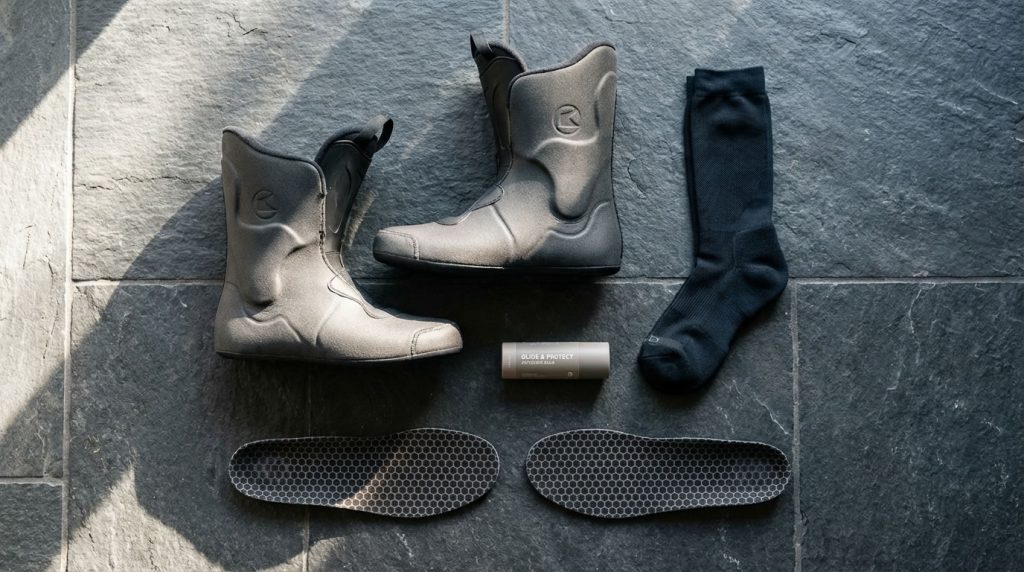
The Skier’s Toolbox: Essential Gear & Resources
Smartwool PhD Ski Ultra Light Socks: Success starts with the sock. Most people go too thick – these provide the “second skin” fit required for precision.
Superfeet or Sidas Custom Footbeds: The single most important internal upgrade. They stabilize the foot and stop the “elongation” that leads to cramped toes.
BodyGlide for Feet: Apply this to your shins to prevent friction-based “shin bang” and to your heels to stop blisters.
Intuition Boot Liners: If the stock liners in your boots feel like cheap pack-foam, these are the gold-standard replacement for warmth and custom-molded comfort.

