

Last Updated on 25th February 2026 by Steve
Washington skiing doesn’t posture for the glossy magazines. It doesn’t need to. While the Rockies sell champagne powder and bluebird days, the Pacific Northwest offers something rawer: storms that swallow chairlifts overnight, unmatched vertical relief, and a local culture that treats bad weather with a shrug and a smile.
For decades, the resorts clustered around Seattle and the Cascades were guarded secrets, content to let the destination travelers fly right over them on their way to Whistler or Utah.
That insularity has shielded the vibe here. It’s less about fur coats and après-ski fashion, and more about Gore-Tex, duct tape, and skiing until your legs give out. But the secret is, inevitably, leaking out. Whether you’re chasing the storm cycles in the North Cascades or hunting drier snow near Spokane, Washington offers a diversity of terrain that rivals any region in North America – if you know how to navigate it.
Map of ski resorts in Washington state

© SkiResorts.net
The Modern Hurdle: Reservations and The Parking Game
Before you even check the freezing level, there is a new reality to contend with. The days of throwing gear in the truck and casually rolling up to the lift at 10 AM are effectively over for the state’s most popular mountains. As demand has surged, the operational landscape has shifted from absolute freedom to managed access.
Crystal Mountain and Stevens Pass have been at the forefront of this change, implementing reservation systems that can catch the uninitiated off guard. On weekends and holidays, grand plans to ski can be derailed by a lack of a parking barcode. It’s no longer just about buying a lift ticket; it’s about securing the pavement to leave your car on.
The systems are designed to incentivize behavior: jam four friends into a Subaru, and you’ll often park for free closer to the lodge. Drive up solo, and you might pay a premium or find yourself locked out entirely.
The Summit at Snoqualmie plays a similar game of capacity Tetris, balancing pass holders against day-trippers.
For the modern visitor, the strategy starts mid-week. You have to stalk the “Getting Here” pages of resort websites, book your slot, and treat parking like a coveted dinner reservation.
It introduces a layer of friction, sure, but it’s the price of admission for the kind of terrain waiting above the parking lot.
Mt. Baker Ski Area
If snowfall is a religion, Mt. Baker is the Vatican. This isn’t a resort in the traditional sense; there are no condos, no heated sidewalks, no village. There is just a road that dead-ends into a prodigious amount of snow.
Baker holds the world record for snowfall in a single season (1,140 inches), and even in an average year, the numbers are staggering. Because the ski area sits in a calm zone between Mt. Baker and Mt. Shuksan, the views – when the clouds break – are hallucinatory. You are skiing right in the face of glaciated giants.
The vibe here is fiercely independent. The terrain is a mix of accessible groomers and hairy, steep chutes that breed some of the world’s best freeriders. Accommodation doesn’t exist at the base; you stay down the winding road in cabin communities or out in Bellingham.
It’s a pilgrimage. You go to Baker to ski, and nothing else.
Mt. Baker Video
Mt. Baker Ski Stats
Lifts: The Mt. Baker ski area has 10 lifts, including eight quad chairlifts
Terrain: The ski area covers 1000 acres
Vertical drop: The difference between the valley and the top station is just under 1600 feet
Longest run: The longest ski run at Mt. Baker is around 9800 feet in length
I LOVED visiting this mountain. It was not crazily expensive, not too crowded and the views were spectacular.
Austin, A Walk and A Lark
Ski Area Website: www.mtbaker.us
Ski resorts near Seattle
Proximity to a tech hub means the resorts along the I-90 and Highway 2 corridors pulse with energy, especially under the floodlights.
The Summit at Snoqualmie
Less than an hour from the Space Needle, The Summit is the backyard playground for the entire Puget Sound region. It’s a sprawling, four-headed beast.
Alpental: This is the outlier. It sits across the highway, dark and brooding. It looks small on a map, but the terrain is terrifyingly steep, riddled with cliffs and backcountry access gates that should only be opened by those with avalanche training and a partner.
Summit West, Central, and East: These areas offer the polar opposite experience – wide, gentle, and lit up like a runway at night. This is where Seattle learns to turn. On a Tuesday night in February, the slopes are alive with office workers glowing under the sodium lights, squeezing in laps after 5 PM.
The Summit at Snoqualmie Video
The Summit at Snoqualmie Ski Stats
Lifts: The four ski areas offer 25 lifts, including 19 chairlifts
Terrain: The ski area covers nearly 2000 acres
Vertical drop: The biggest difference between the valley and the top station is at Alpental with 2280 feet of vertical
Longest run: The longest ski run is at Alpental and is around 1.2 miles in length
Generations of Seattle skiers still carve their first turns along the gentle slopes at Summit West and graduate to the steep cliff runs that mark Alpental’s Edelweiss Chair.
Seattle Times
Ski Area Website: summitatsnoqualmie.com
Crystal Mountain Ski Resort
Crystal is the heavyweight. It’s the only resort in Washington that feels like a “big mountain” destination in the Rockies sense.
Tucked in the shadow of Mount Rainier, it offers a gondola, high-alpine bowls, and a vertical drop that will burn your quads long before you reach the bottom.
The 2,600 acres of terrain feel massive because they are. You can spend the morning hunting powder in Northway and the afternoon carving groomers under the Forest Queen. It’s huge, it’s expensive, and on a clear day, staring straight into the volcanic crater of Rainier, it is worth every penny.
Crystal Mountain Video
Crystal Mountain Ski Stats
Lifts: The ski lifts consist of an eight-seater gondola and ten chairlifts
Terrain: The ski area covers 2300 acres (lift-served) or 2600 acres (including inbounds backcountry)
Vertical drop: The difference between the valley and the top station is around 3000 feet of vertical
Longest run: The longest ski run is around 2.5 miles in length
Washington’s largest and highest-elevation ski resort has the amenities – with a top-of-the-mountain restaurant, two lodges, a gondola and four high-speed lifts – to match some of the best ski resorts in North America.
Spokesman-Review, Spokane
Ski Area Website: www.crystalmountainresort.com
Ski resorts in central Washington state
Stevens Pass Mountain Resort
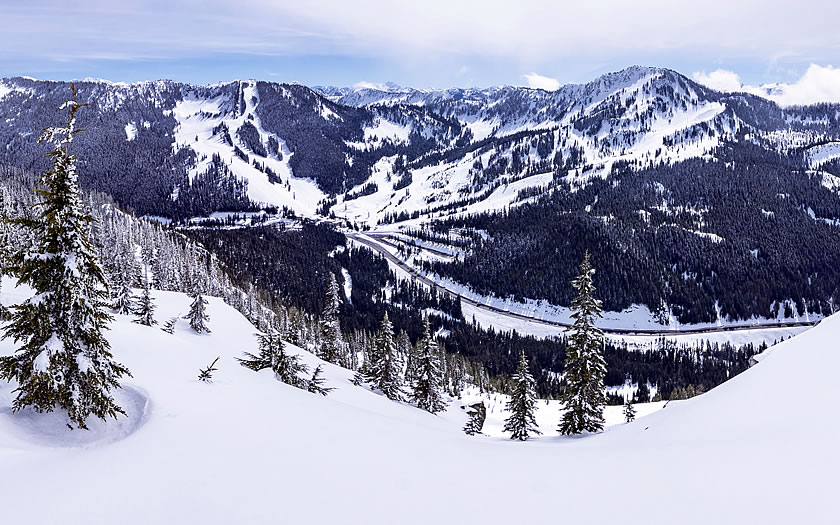
Ninety minutes east of the city, Stevens Pass splits the difference between a local hill and a destination resort. Now under the Vail Resorts umbrella, it has seen infrastructure upgrades and the growing pains that come with them (hence the parking reservations).
The terrain is uniquely split. The front side is a maze of intermediate runs and terrain parks, while the backside – Mill Valley – offers a distinct, open-bowl feel that catches the sun.
It’s a skier’s mountain, famous for the “Seventh Heaven” chair that serves up steeper, jagged lines for those willing to work for them.
Stevens Pass Ski Stats
Lifts: Uphill capacity is consists of ten chairlifts
Terrain: The ski area covers 1125 acres on two sides of the mountain
Vertical drop: The vertical difference between the valley and the top station is 1800 feet
Longest run: The longest ski run is just over a mile in length
Ski Area Website: www.stevenspass.com
Crossing the Cascade Crest
When you drive east over the passes, the world dries out. The moss disappears, replaced by ponderosa pine, and the heavy “Cascade Concrete” snow transforms into something lighter and faster.
Mission Ridge
Perched above Wenatchee, Mission Ridge is an anomaly. It has more sunny days than anywhere else in the state and a casual, low-stress atmosphere.
The sheer distance from Seattle keeps the crowds thinner, and the snow quality is often vastly superior to the wet precip falling on the west side. It’s 2,000 acres of basalt cliffs and fast bombers, with a rope tow system in the park that breeds incredibly technical riders.
Mission Ridge Video
Mission Ridge Ski Stats
Lifts: The ski area has four chairlifts and two rope tows (one rope tow being for the terrain park)
Terrain: The ski area covers 2000 acres
Vertical drop: The vertical difference between the valley and the top station is 2250 feet
Longest run: The longest ski run is just just under two miles in length
We absolutely love skiing at Mission Ridge. The views are beautiful, lots of great runs for all abilities, short lift lines & friendly staff.
Wendy, Washington
Ski Area Website: www.missionridge.com
Loup Loup Ski Bowl

The ski hill at Loup Loup is a smaller area run by a non-profit volunteer group in the Methow valley between Twisp and Okanogan. The skiing is open four days a week (Wednesday and Friday to Sunday) and offers three lifts (one chairlift) and ten ski runs on 1240 vertical feet and 300 acres of terrain.
The ski area also has a terrain park, a tubing hill open at weekends and groomed cross country skiing trails.
Ski Area Website: skitheloup.com
Ski resorts in eastern Washington state
49 Degrees North Mountain Resort
This is big mountain skiing without the ego. Located near Chewelah, it offers massive glades and long, rolling groomers. It feels like stepping back in time to when skiing was simply about sliding down a hill with friends.
49 Degrees North Video
49 Degrees North Ski Stats
Lifts: The ski area has six chairlifts and one conveyor lift near the base area
Terrain: The ski area covers 2325 acres
Vertical drop: The vertical difference between the valley and the top station is 1850 feet
Longest run: The longest ski run is 2.75 miles in length
A great family ski hill with a good variety of skill levels available. We’ve never really had to wait in line and the conditions are always good when we’ve visited.
John, Hawaii
Ski Area Website: www.ski49n.com
Mt. Spokane Ski Area
This is the town hill, but don’t let the moniker fool you. With 2,000 vertical feet and night skiing, it punches well above its weight class. It’s run by a non-profit, purely for the love of the sport, offering a stark contrast to the corporate consolidation happening elsewhere.
Mt. Spokane Video
Mt. Spokane Ski Stats
Lifts: The ski area has eight lifts, including six chairlifts
Terrain: The ski area covers 1700 acres
Vertical drop: The ski area offers 2000 skiable vertical feet
Night skiing: Night skiing is available from Wednesday to Saturday
Spokane has never developed a significant reputation as a destination ski town; however, almost everyone agrees that the Mt. Spokane Ski & Recreation Area is a jewel and that the skiing is affordable and super convenient.
outthereoutdoors.com
Ski Area Website: www.mtspokane.com
Ski resorts in southern Washington state
White Pass Ski Resort
Halfway between Seattle and Portland, White Pass serves a loyal constituency who prefer its laid-back nature to the frenzy of the I-90 resorts.
Famous for raising the Olympic-medal-winning Mahre brothers, the terrain here is fantastic for progression. The expansion into Paradise Basin opened up vast intermediate acreage that feels wild and remote, offering views of Rainier that rival Crystal’s, but with half the lift line wait.
White Pass Video
White Pass Ski Stats
Lifts: The ski area has six chairlifts and two surface lifts
Terrain: The ski area covers 1400 acres
Vertical drop: The ski area offers a vertical of 2000 feet
Night skiing: Night skiing is available on Saturdays and holidays
Generally White Pass is a pretty easy resort but there was enough challenge to keep us interested for a day or two.
skinorthamerica100.com
Ski Area Website: skiwhitepass.com
Ski Bluewood

Bluewood was developed in the Eighties in the Umatilla National Forest in southeastern Washington south of Dayton. The small ski area (with two chairlifts and two surface lifts) is open four or five days a week during most of the winter season. It has 24 trails, the longest being 2.25 miles, and 1125 feet of vertical. The ski area is implementing a three-year-plan of lift upgrades and the introduction of a snowmaking area near the base.
Ski Area Website: bluewood.com
Local Gear Recommendations
- Waterproofs: Forget water-resistant. In Washington, you need 20k/20k waterproof ratings or strict Gore-Tex. (Brands like Trew Gear and Outdoor Research are based here for a reason).
- Low Light Lenses: You will rarely need dark tint. Invest in high-contrast “storm” lenses (yellow, rose, or clear) for the flat light conditions common in January.


